
How to Test Your Heating System Before the First Cold Night
The first genuinely cold night in the Central Valley tends to arrive without much warning, and it almost always lands on a week when nobody has thought about the furnace since March. Testing your heating system in early fall gives you a low pressure window to find problems while the weather is still mild and while parts and appointments are still easy to get. A test run takes about thirty minutes of your time, requires no tools beyond a screwdriver and a fresh air filter, and tells you a great deal about the condition of the equipment sitting in your hallway closet, attic, or garage. Most heating failures announce themselves in small ways long before the system quits completely, through delayed ignition, weak airflow, odd smells, or a thermostat that no longer holds the setting you gave it. Homeowners in Visalia, Tulare, Hanford, and the surrounding towns often skip this step because winter here feels short and forgiving, yet a system that sat idle for seven months in dusty valley air is exactly the kind of system that struggles on its first real call for heat. This guide walks through how to test your heating system safely, what a healthy startup sequence should look and sound like, and which results mean you should stop and call a licensed technician. Everything below applies to gas furnaces, electric furnaces, and heat pumps, since all three are common across Tulare and Fresno counties.
How to Test Your Heating System Step by Step at Home
A proper heating system test follows a sequence, because each stage depends on the one before it. You start with the filter and the power supply, move to the thermostat, then watch what the equipment does during startup, and finish by checking airflow and temperature at the registers throughout the house. Doing it in that order keeps you from chasing a symptom that turns out to be a clogged filter or a tripped breaker. Pick a cool morning if you can, since a large difference between indoor and outdoor temperature makes weak performance much easier to notice. Give yourself twenty to thirty minutes of uninterrupted time, and open a couple of windows before you begin so the first burn off of summer dust has somewhere to go. Keep your phone nearby and write down anything that seems unusual, because the details you notice during the test are exactly what a technician needs to hear later.
The First Heating System Test Starts at Your Thermostat
Before you touch anything else, clear the area around your indoor unit and confirm that the equipment actually has power. Most furnaces and air handlers have a dedicated switch on or near the cabinet that looks exactly like an ordinary light switch, and it gets flipped off by accident more often than anyone would guess. Check the breaker panel as well, since a heat pump uses one breaker for the outdoor unit and a second, usually larger, breaker for the indoor air handler and its backup heat strips. If you have a gas furnace, verify that the shutoff valve on the gas line runs parallel with the pipe rather than across it. Replace the air filter now instead of later, because a filter that spent a long valley summer catching dust, pollen, and agricultural particulate will choke airflow and skew every result that follows. Note the size printed on the frame so you can buy the correct replacement, and slide the new one in with the arrow pointing toward the furnace. Only after all of that should you move to the thermostat.
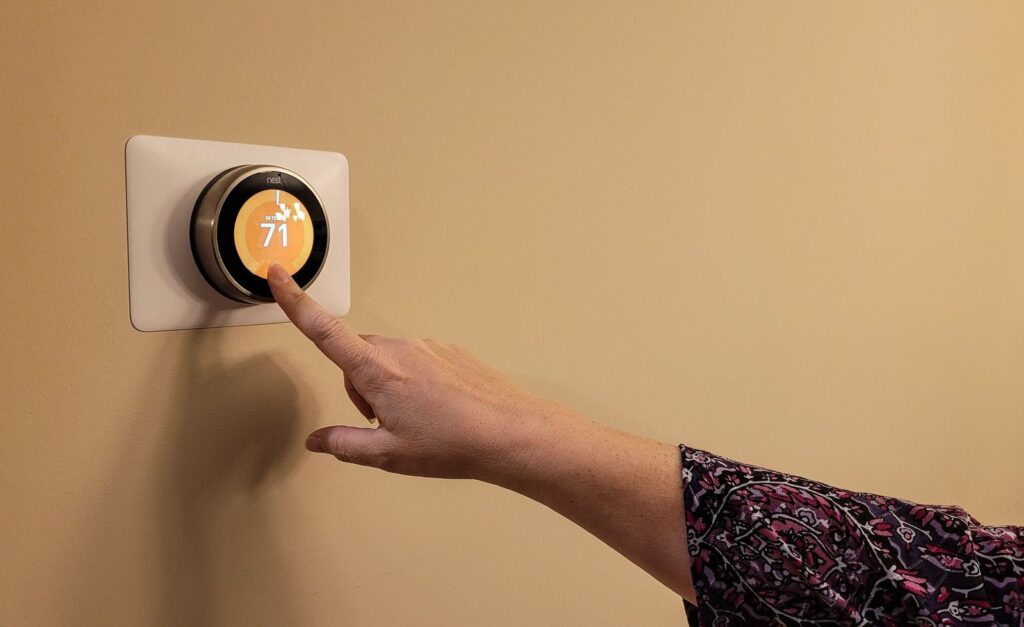
At the thermostat, set the mode to Heat and raise the target temperature about five degrees above the current room reading, which guarantees a clear call for heat rather than a borderline one. Battery powered thermostats should get fresh batteries at this point, since a weak battery produces intermittent behavior that mimics an equipment failure. Listen for a soft click within a few seconds, then walk to the furnace or air handler and watch what happens. A gas furnace runs a predictable sequence: the inducer motor spins up first and runs for roughly thirty to sixty seconds to purge the flue, the igniter glows, the gas valve opens, the burners light, and the main blower joins in about thirty to sixty seconds after that once the heat exchanger warms. The blower delay is normal and prevents a rush of cold air into the house. If the sequence stalls at any point, or if the unit tries three times and then goes quiet, you have found something worth reporting.
Thermostat problems produce some of the most confusing heating symptoms, so pay attention to how the display behaves during the test. A thermostat that reads several degrees off from a separate room thermometer may be mounted in a bad spot, sitting in direct sun, or affected by a draft coming through the wall behind it. Smart thermostats introduce another variable, because many models need a common wire for steady power and some need specific configuration to control a heat pump correctly. Setting a heat pump thermostat up as a conventional furnace is a frequent installation error, and it usually shows up as backup heat running far more than it should. If the display goes blank, resets on its own, or holds a setting for only a short time before drifting, the control side deserves attention before anyone starts replacing parts inside the furnace. Need a thermostat upgrade or a repair on a unit that is not holding its setting? Click here for our thermostat services.
How to Test Your Heating System Airflow at Every Vent
Once the blower has been running for five to ten minutes, walk the entire house with your hand at each supply register and take note of what you feel. Every room should deliver noticeable warm air, and the difference between the closest register and the farthest one should be modest rather than dramatic. Bedrooms at the end of a long duct run in an attic almost always run a little weaker, though a room that gets nearly nothing points to a duct problem, a closed damper, or a disconnected branch. Make sure supply registers are fully open and that furniture, rugs, and curtains are not sitting on top of them. Closing off vents in unused rooms is a popular idea that quietly raises static pressure inside the ductwork and forces the blower to work against resistance it was never designed to handle. Check the return grille as well, since a blocked or undersized return starves the entire system regardless of how clean the supply side looks. Airflow is the foundation of heating performance, and a system that cannot move air cannot deliver heat no matter how well the burners are firing.
A more precise version of this check uses two inexpensive thermometers to measure temperature rise, which is the difference between the air entering the furnace and the air leaving it. Place one probe in the return duct near the cabinet and another in the supply plenum a short distance downstream of the heat exchanger, then let the unit run for about ten minutes before reading both. Every gas furnace has a rating plate listing an acceptable temperature rise range, commonly somewhere between thirty and seventy degrees Fahrenheit depending on the model. A reading above the listed range usually means restricted airflow from a dirty filter, a dirty blower wheel, undersized returns, or crushed ductwork, and that condition overheats the heat exchanger and shortens its life. A reading below the range can indicate an oversized blower, an incorrectly staged gas valve, or a gas pressure issue. Homeowners who prefer not to take these readings themselves can simply note how warm the supply air feels compared to previous winters and mention it during a service visit.
Heat pump owners should expect something different at the registers, and knowing that in advance prevents a great deal of unnecessary worry. A heat pump in heating mode typically delivers supply air somewhere around ninety to one hundred degrees Fahrenheit, which is warm but noticeably cooler than the air a gas furnace produces. Because that air sits close to skin temperature, it can feel lukewarm against your hand even when the system is performing exactly as designed. What matters is that the room temperature climbs steadily and that the unit eventually satisfies the thermostat and shuts off. Air that feels genuinely cool, or a system that runs continuously without ever reaching the setpoint, is a different story and suggests a refrigerant, reversing valve, or defrost control problem. Keep a rough sense of how long a full cycle takes in October so you have a baseline to compare against in January.
What to Listen For and Smell For During a Heating System Test
Sound tells you a great deal about mechanical condition, and the first startup of the season is the best listening opportunity you will get. A healthy furnace produces a steady hum from the inducer, a brief whoosh as the burners light, and consistent blower noise that stays even throughout the cycle. A loud boom or a delayed thump at ignition means gas is accumulating before it lights, which is usually caused by dirty burners, a weak igniter, or a partially blocked flue, and it puts real stress on the heat exchanger. A high pitched squeal often traces back to a blower motor bearing or a slipping belt on older units. Rattling and buzzing sometimes come from nothing more than a loose panel screw, though grinding and scraping suggest a motor or wheel making contact with something it should not touch. Repeated clicking without ignition points to an igniter or gas valve issue. Write down the noise, when it occurs in the cycle, and how long it lasts, since that description often narrows the diagnosis before a technician even removes a panel.
Smell deserves the same attention, with one important exception. A dusty, slightly scorched odor during the first ten to thirty minutes of the season is normal and comes from dust burning off the heat exchanger and burner assembly after months of inactivity. Open a few windows, let the system run, and that odor should fade and never return for the rest of the winter. An odor that persists past the first hour, or that returns on later cycles, is not normal and needs to be investigated. A sharp electrical or plastic smell suggests overheating wiring, a failing motor, or a control board problem, and the correct response is to shut the system down at the thermostat and at the disconnect switch. Musty odors that arrive with the airflow usually originate in the ductwork rather than the equipment.
Gas odor is the one situation with no gray area at all. If you smell sulfur or rotten eggs, leave the house immediately, do not touch light switches or appliances, and call your gas utility and emergency services from outside. This is also the right moment to test every carbon monoxide detector in the home, because combustion appliances and CO detection belong together. Detectors should be placed on every level and near sleeping areas, they should be replaced roughly every seven to ten years depending on the manufacturer, and the test button confirms the alarm works but does not confirm sensor accuracy. A cracked heat exchanger can allow combustion gases into the airstream without producing any smell that a person would notice, which is precisely why annual professional inspection matters on gas equipment. Any alarm activation means getting everyone outside first and calling for help second.
Heating System Test Results That Mean You Need Furnace or Heat Pump Repair
Some test results simply confirm that your system is ready for the season, and others tell you to stop and pick up the phone. The distinction usually comes down to consistency and safety: intermittent behavior, unusual combustion, and anything involving fuel or carbon monoxide belongs in professional hands. Central Valley heating equipment lives a strange life, running hard for a handful of weeks and then sitting untouched for most of the year, which tends to produce failures related to corrosion, dust accumulation, and stuck components rather than pure wear. The good news is that most of what a fall test uncovers is inexpensive to fix in September and October, when technicians are not fighting through a backlog of no heat calls. The following sections cover the most common findings on gas furnaces, on heat pumps, and inside the duct system that connects everything together. Match your results against these descriptions before you decide how urgent your situation really is.
Heating System Test Warning Signs That Point to Furnace Repair
Short cycling is the single most common complaint that follows a first startup, and it describes a furnace that lights, runs for a brief period, shuts down, and then tries again. When the shutdown happens within a few seconds of the burners lighting, the usual culprit is a dirty flame sensor, a thin metal rod that confirms flame presence and signals the control board to keep the gas valve open. Corrosion or soot on that rod causes the board to assume no flame exists, so it closes the valve as a safety measure, retries a set number of times, and finally locks out. When the shutdown happens several minutes into a cycle instead, restricted airflow is the more likely cause, because the limit switch is protecting an overheating heat exchanger. Both conditions are repairable, and both get worse when ignored. A furnace that repeatedly enters lockout is trying to tell you something, and resetting the power over and over only postpones the diagnosis.
Flame appearance offers another useful clue on gas equipment. Burner flames should burn crisp and blue with perhaps a small yellow tip, and a steady, even pattern across all burners indicates clean combustion. Lazy yellow or orange flames that flicker and roll suggest incomplete combustion from dirty burners, poor combustion air supply, or a venting problem, and incomplete combustion is what produces carbon monoxide. Soot or rust colored streaking around the burner compartment, water pooling at the base of the unit, or a rollout switch that keeps tripping all warrant an immediate professional inspection. High efficiency condensing furnaces add one more item to the list, because they produce acidic condensate that drains through a small tube, and a clogged drain or a tripped float switch will shut the unit down entirely. Age matters too, since most gas furnaces run fifteen to twenty years and the failure rate climbs steeply past that point.
Electric furnaces present a slightly different set of symptoms during a heating system test. They have no combustion, no flue, and no carbon monoxide risk, though they do rely on resistance heating elements and sequencers that engage in stages. A common finding is warm air that never quite reaches expected temperature, which often means one element or one sequencer has failed while the others continue working. Breakers that trip during heating operation indicate a serious electrical fault and should never be repeatedly reset. Because electric heat is expensive to run in the Central Valley compared to gas or a heat pump, a partially failed system frequently shows up on the utility bill before anyone notices a comfort problem. Getting an unusual test result on any type of furnace? Click here for our furnace repair and maintenance services.

Heating System Test Warning Signs That Point to Heat Pump Repair
Heat pumps are increasingly common across Visalia, Tulare, Hanford, and Fresno, and they behave differently enough from furnaces that homeowners often misread normal operation as a malfunction. During a heating call, the outdoor unit should run just as it does in summer, since the system is pulling heat from outdoor air and moving it inside. If the indoor blower runs while the outdoor unit sits silent, the system is almost certainly heating with backup electric resistance strips alone, which is both expensive and a clear sign that something upstream has failed. A loud whooshing or a distinct clunk from the outdoor unit when the mode changes usually comes from the reversing valve, the component that flips the refrigerant flow between heating and cooling. A reversing valve that sticks partway will leave the system stuck in one mode or blowing air that never gets warm. Clear at least two feet of space around the outdoor unit and remove any leaves, weeds, or stored items pressed against the coil.
Defrost operation is another normal behavior that alarms people the first time they see it. On cold, damp valley mornings, frost forms on the outdoor coil and the system periodically reverses itself briefly to melt it, producing steam, a temporary change in sound, and a short interruption in warm air indoors. A defrost cycle should last only a few minutes and end on its own, and backup heat typically engages during that window to keep the supply air comfortable. Frost that never clears, ice building up over the entire outdoor unit, or defrost cycles that repeat every few minutes all indicate a control, sensor, or refrigerant charge problem. Test your system on a cool morning specifically so you can observe this behavior before winter arrives.
Auxiliary and emergency heat settings cause more confusion and more high utility bills than any other heat pump feature. Auxiliary heat engages automatically to supplement the compressor when outdoor temperatures drop or when the thermostat calls for a large temperature jump, and occasional operation is completely normal. Emergency heat, on the other hand, shuts the compressor out of the picture entirely and runs on resistance heat alone, which can cost two to three times as much to operate. That setting exists for situations where the outdoor unit has genuinely failed, not for cold nights. If your thermostat shows auxiliary heat running for hours at a stretch in mild valley weather, the compressor is likely underperforming or the charge is low. Seeing any of these symptoms on your system? Click here for our heat pump services.
Heating System Test Problems That Start in Your Air Ducts
A duct system that leaks will undermine even a brand new furnace, and duct problems are widespread in Central Valley homes where the majority of the distribution system runs through an unconditioned attic. Industry research consistently finds that typical residential duct systems lose roughly twenty to thirty percent of the air moving through them to leaks at joints, boots, and connections. In an attic that sits cold on a January morning, every bit of that lost air is heat you paid for and never received. During your heating system test, weak or nonexistent airflow at a single register is the classic signature of a disconnected flex duct or a crushed run. Rooms that never quite match the rest of the house, uneven temperatures between the front and back of the home, and a system that runs constantly without satisfying the thermostat all trace back to the duct system more often than homeowners expect. Visual inspection from the attic access can reveal obvious separations, though most leakage happens in places that are difficult to see.
Insulation condition matters as much as air tightness. Flex duct sold for residential use carries a rated insulation value, and that rating means very little once the outer jacket is torn, compressed under stored boxes, or degraded by decades of attic heat. Long runs draped across joists develop sags and sharp bends that restrict airflow the same way a kinked garden hose restricts water. Older homes in and around Visalia sometimes still have original ductwork that has been modified repeatedly over the years by different contractors, producing a system that no longer matches the equipment attached to it. Sealing accessible joints with mastic and repairing damaged sections is usually far less expensive than a full replacement and delivers an immediate improvement in both comfort and efficiency.
Air quality is the other half of the duct conversation, and it becomes noticeable the moment the heat comes on for the first time. Agricultural dust, fine soil, and pollen accumulate inside the system all summer, and leaky return ducts actively pull attic air, insulation fibers, and dust into the airstream. Rodent activity in attics is common throughout Tulare and Fresno counties, and damaged ductwork gives pests direct access to the air your family breathes. Musty or dusty odors that appear only when the blower runs, visible debris around register faces, or a noticeable increase in dust settling on furniture after the heating season starts are all worth investigating. Cleaning and sealing address both the comfort side and the health side at the same time. Noticing weak airflow or dusty air during your test? Click here for our air duct services.
Why You Need a Professional Heating System Test Before the First Cold Night
A homeowner test catches the obvious problems, and that alone makes it worth doing every September. What it cannot do is measure gas pressure, verify combustion, inspect a heat exchanger for cracks, check refrigerant charge, or evaluate electrical components under load. Those checks require training, instruments, and a license, and they are the ones that protect both your safety and the lifespan of equipment that costs thousands of dollars to replace. Scheduling professional service in early fall also means you are choosing your appointment time instead of waiting in line behind everyone else on the first freezing night. The cost of a seasonal tune up is small compared to a compressor replacement, a heat exchanger failure, or a night spent without heat.
What a Professional Heating System Test Includes
A thorough professional heating inspection covers combustion, airflow, electrical, and controls as one connected system rather than a checklist of isolated parts. On gas equipment, that means inspecting and cleaning burners, testing the flame sensor and igniter, verifying gas pressure against manufacturer specification, examining the heat exchanger, and confirming that the flue vents properly to the outside. Technicians measure temperature rise across the unit and compare it to the rating plate, which reveals airflow restrictions that a hand at a register would never detect. Electrical testing includes checking capacitors, contactors, motor amp draw, and wiring connections that loosen over time from vibration and thermal cycling. Safety controls such as limit switches, rollout switches, and pressure switches get verified rather than assumed.
Heat pump service follows a parallel path with different specifics. A technician confirms refrigerant charge using pressures and temperatures rather than guesswork, tests defrost operation, verifies the reversing valve actually shifts, and checks that auxiliary heat strips engage only when they should. Coil condition on both the indoor and outdoor units gets inspected, since a dirty coil reduces heat transfer in winter exactly as it does in summer. Thermostat configuration is reviewed to confirm the system is set up correctly for heat pump operation, which is a surprisingly frequent source of high bills. Condensate drainage, filter fit, and blower wheel cleanliness round out the visit.
Documentation is the part homeowners tend to overlook and later appreciate. A written record of measurements taken this year gives you a baseline to compare against next year, which makes gradual decline visible long before it becomes a failure. That record also supports manufacturer warranty coverage, since most warranties require documented annual maintenance to remain valid. When repair eventually becomes replacement, having a service history makes the decision far easier to reason through. Regular professional attention is the difference between planning an upgrade and reacting to an emergency.
How an Early Heating System Test Saves Money on Winter Energy Bills
Efficiency losses accumulate quietly, and most homeowners never notice them because the change happens gradually across several seasons. A clogged filter, a dirty blower wheel, low refrigerant charge, or leaking ductwork each force the system to run longer to reach the same indoor temperature, and longer runtime shows up directly on the utility bill. Correcting those issues in early fall means the savings apply to every cold night that follows rather than to the tail end of the season. For heat pump owners, keeping the compressor operating properly prevents backup resistance heat from carrying a load it was never meant to carry, which is one of the largest avoidable heating expenses in the Central Valley.
Equipment lifespan represents the larger financial picture. Systems that run under restricted airflow, poor combustion, or incorrect charge experience higher internal temperatures and more frequent cycling, and both conditions shorten component life considerably. Replacing a capacitor or cleaning a flame sensor costs very little; replacing a compressor or a heat exchanger does not. Annual maintenance consistently proves less expensive over a ten year window than deferred service followed by a major repair. Small problems stay small only when someone finds them early.
Timing carries its own value. Heating contractors across Tulare and Fresno counties see call volume spike the moment temperatures drop, and emergency service during that window costs more and takes longer to schedule. Testing in September and October means parts are available, appointments are flexible, and any needed repair can be planned rather than rushed. Financing a planned replacement is also far easier than financing one made under pressure at ten o’clock on a cold night. A little advance work buys you options.
Why Choose Breezio AC for Your Heating System Test in Visalia
Breezio AC brings more than thirty years of hands on HVAC experience to every furnace and heat pump we service, and we are fully licensed and insured in California. Our technicians work on residential and commercial systems throughout Visalia, Tulare, Hanford, Porterville, Dinuba, Exeter, Lemoore, Selma, Reedley, Fresno, and the surrounding communities. We handle furnaces, heat pumps, mini split systems, thermostats, air conditioning, air ducts, and kitchen hood cleaning, so one call covers the whole system rather than a single piece of it. Emergency HVAC service is available twenty four hours a day, seven days a week, because heating problems rarely wait for business hours. Flexible financing options are available on installations and larger repairs.
Every installation we perform includes a two year maintenance plan, which keeps your new equipment inspected, adjusted, and documented from the day it goes in. That commitment reflects how we think about this work: a system installed correctly and maintained consistently delivers better comfort, lower bills, and a longer service life than one that gets attention only when it breaks. We explain what we find in plain language, show you the measurements behind our recommendations, and let you decide how to proceed. Straight answers and honest pricing have earned us 5 star reviews across the valley. We would rather keep a customer for twenty years than sell one unnecessary repair today.
Scheduling your heating system test before the first cold night is the easiest thing you can do for your home this fall. Call Breezio AC at (559) 202-0224, email us at support@breezioac.com, or visit our office at 7730 W Sunnyview Ave #5, Visalia, CA 93291. We will inspect your furnace or heat pump, test every safety control, verify airflow and combustion, and give you a clear picture of what to expect this winter. If a repair is needed, you will know about it while the weather is still mild and while you still have time to plan. Reach out today and head into the cold season with confidence.